
NVIDIA has just introduced something that could reshape how developers work with AI models — the NVIDIA DGX Spark Mini PC. Imagine holding a supercomputer in the palm of your hand — that’s what the Spark promises to deliver. With its GB10 Grace Blackwell superchip, 128GB of unified memory, and the ability to handle models up to 200 billion parameters, this compact device is designed to bring serious AI power to your desk without the cloud rental fees.
While the Spark doesn’t outperform a high-end consumer setup — like a dual RTX 4090 rig — in raw inference speed, it shines in other crucial areas: memory capacity, multi-model performance, and fine-tuning capabilities. It’s less about raw speed and more about doing more things at once.
Inside the NVIDIA DGX Spark
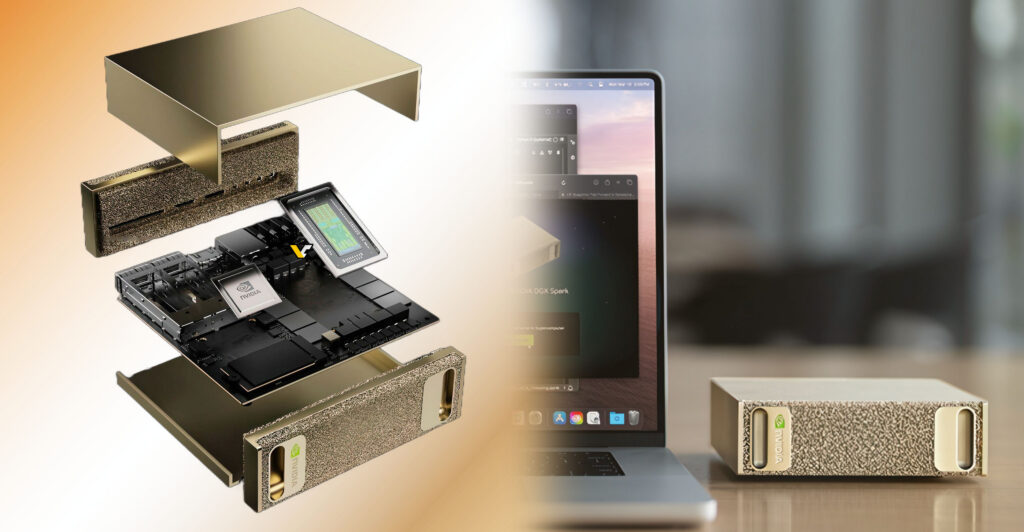
At its heart, the DGX Spark is powered by the Grace Blackwell GB10 superchip, combining a 20-core ARM CPU with a Blackwell GPU capable of a staggering 1 petaflop of AI compute. It packs 128GB of LPDDR5X unified memory, allowing both the CPU and GPU to share the same pool of memory — a huge leap in efficiency for AI workloads.
NVIDIA DGX Spark has small size — reportedly not much bigger than a coffee cup — it’s built for serious work. With 10Gb Ethernet, up to 200 billion parameter model support, and a $4,000 price tag, NVIDIA positions the Spark as an accessible, developer-friendly AI supercomputer.
The Dual 4090 Showdown VS DGX Spark
In testing, the Spark went head-to-head with a dual RTX 4090 setup. For smaller models, Dual RTX $4090 won easily — running models like Quinn 38B at almost four times the speed. However, the DGX Spark’s 128GB unified memory gave it a unique advantage: it could run multiple large models simultaneously, something dual RTX 4090 simply couldn’t handle with just 48GB of VRAM.
That means while dual RTC 4090 is a sprinter, the DGX Spark is a marathon runner — capable of handling longer, more complex AI tasks without running out of memory.
FP4 Quantization: Efficiency Redefined
One of Spark’s most powerful features is its hardware-level support for FP4 quantization. In simple terms, this allows AI models to run faster and more efficiently by using lower precision (FP4 instead of FP16) — without sacrificing too much quality. Unlike consumer GPUs that handle FP4 in software, the Spark’s hardware is built specifically for it, making it a game-changer for smaller AI models and speculative decoding, a technique that drastically speeds up text generation.
Designed for Developers, Not Just Gamers
The DGX Spark isn’t built for gaming — it’s built for AI developers, researchers, and data scientists. Its unified memory, low power draw, and easy access via NVIDIA Sync or remote tools like Tailscale make it ideal for local model training and fine-tuning.
Even better, it’s cost-efficient. Running 24/7 only costs around $315 per year with 240 watts TDP, compared to a dual 4090 setup that can exceed 1100 Watts and cost $1,400 annually in electricity alone. For developers who usually rent cloud GPUs, the Spark could pay for itself in months.
