A Breakthrough in AI-Powered Alzheimer Diagnosis
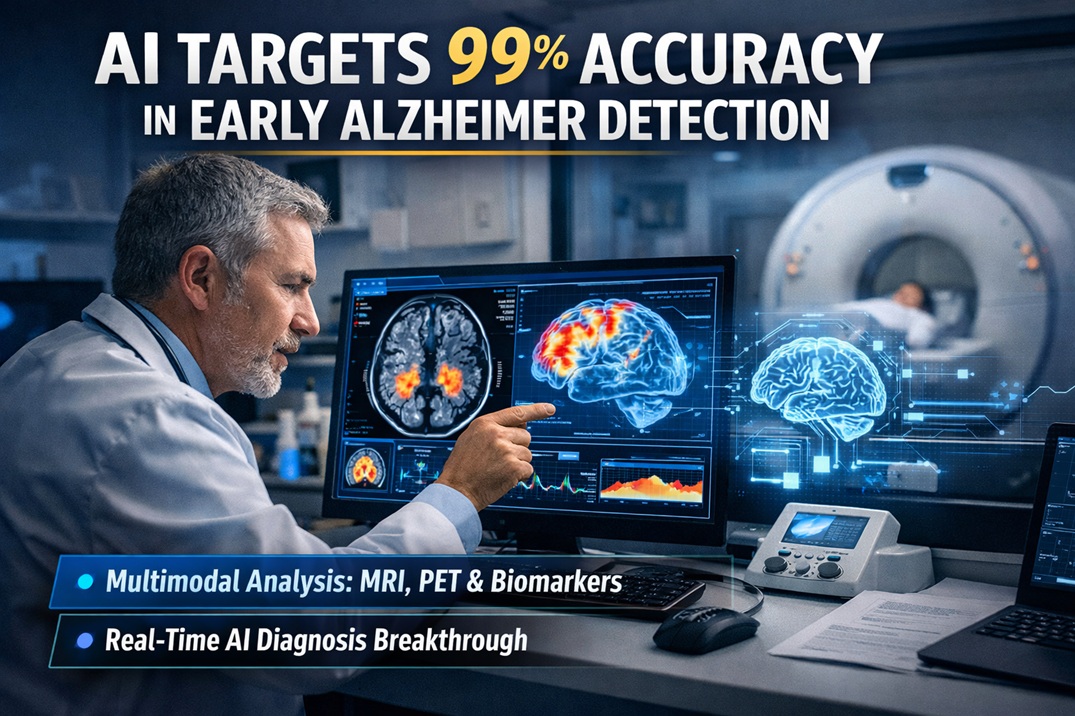
A newly developed deep learning–based artificial intelligence (AI) system is aiming to achieve up to 99% accuracy in early Alzheimer’s disease detection. The platform integrates multimodal medical data including 3D MRI scans, PET imaging, cerebrospinal fluid biomarkers, and digital phenotyping and is designed for real-time clinical use with processing latency under 200 milliseconds. At the same time, healthcare technology companies such as Philips are beginning to embed similar AI tools directly into MRI workflows, signaling a major shift toward faster and more precise neurological diagnostics.
Why This Technology Matters for Global Healthcare
Alzheimer’s disease represents one of the most pressing global health challenges, with more than 50 million dementia cases worldwide. The disease can silently alter brain structures years before symptoms become visible, making early detection critical for effective intervention and treatment planning.
As healthcare systems increasingly adopt digital technologies and AI-driven radiology tools, there is growing demand for systems capable of analyzing complex medical data quickly and reliably. Multimodal AI platforms address limitations of manual image analysis which is often time-consuming and inconsistent while also tackling key issues such as patient data privacy and the scarcity of large medical datasets.
How the AI Alzheimer Detection System Works
Hybrid Neural Architecture for Brain Analysis
The system employs a hybrid architecture that combines 3D Convolutional Neural Networks (CNNs) and Vision Transformers (ViTs). The 3D CNN component extracts fine-grained local structural features from brain scans, while Vision Transformers analyze global relationships between distant brain regions to identify early connectivity disruptions.
The model processes multiple data sources, including:
- T1-weighted 3D MRI scans for structural brain analysis
- PET scans measuring beta-amyloid plaque density
- Cerebrospinal fluid (CSF) biomarkers such as tau proteins
- Digital phenotyping and clinical patient data
MRI data undergoes advanced preprocessing including bias field correction, automated skull stripping, and spatial normalization to the MNI 152 standard template to ensure consistent and high-quality inputs.
Multimodal Data Fusion
To capture cross-modal relationships, the system uses multimodal fusion strategies that combine imaging and biomarker data within a shared latent space. Regularization techniques help prevent the model from over-relying on any single data modality, improving robustness and generalization.
Interpretability and Clinical Transparency
For clinical adoption, interpretability is essential. The system incorporates Grad-CAM and SHAP techniques to generate visual heatmaps and feature importance explanations. These tools allow physicians to understand why predictions are made, supporting regulatory compliance and building clinical trust.
Industry Implementation: Philips Smart Reading
A practical example of AI integration in medical imaging is Philips Smart Reading, which embeds AI directly into MRI workflows. The technology can:
- Improve image sharpness by up to 65%
- Reduce scan times by nearly threefold
- Automatically measure brain volume changes
- Generate structured reports in real time
This automation accelerates diagnosis, increases workflow efficiency, and allows radiologists to focus more on patient care.
Key Quotes and Supporting Data
According to the system’s developers:
“There are currently more than 50 million global cases. Our AI pipeline aims to achieve 99% early detection accuracy.”
They also emphasize the importance of transparency in medical AI:
“Black-box models are not useful in medicine. Doctors must understand why a prediction is made.”
To protect patient privacy, the system uses federated learning, enabling hospitals to train models collaboratively without sharing raw patient data. This approach complies with privacy regulations such as HIPAA and GDPR.
Impact, Implications, and Future Outlook
AI-driven early Alzheimer detection could transform healthcare from a reactive model to a proactive, prevention-focused approach. Faster and more accurate diagnosis enables earlier intervention and supports personalized treatment strategies. Integrated AI workflows can also improve operational efficiency in imaging centers and reduce clinician workload.
Future research directions include:
- Longitudinal disease progression analysis
- Temporal neural models to predict symptom timelines
- Reinforcement learning for personalized preventive interventions
If clinical validation and regulatory approval continue to advance, multimodal AI systems are expected to become a foundational component of next-generation healthcare shifting medicine toward data-driven prevention and precision care.
