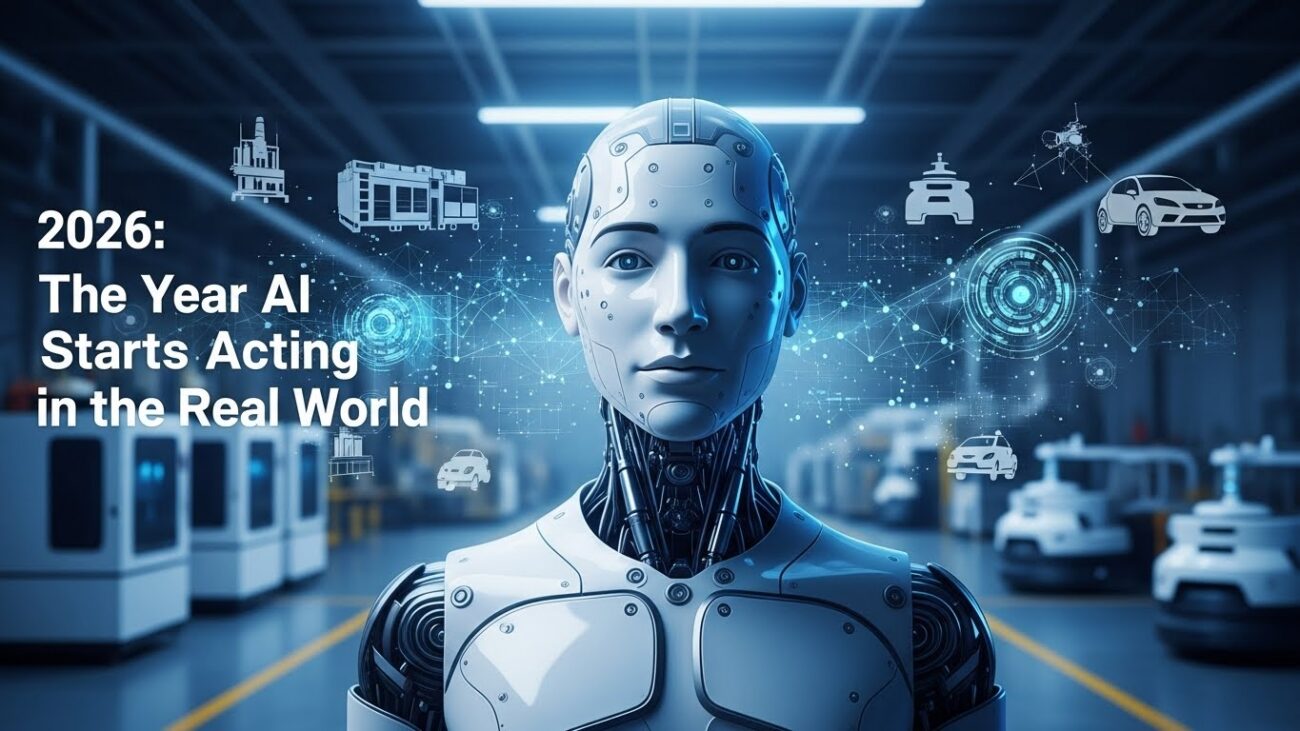
Artificial Intelligence is entering a completely new era. For years AI has been associated with digital tasks such as writing, image creation, or analyzing data. Now the focus is shifting to Physical AI 2026, where machines are not only capable of thinking but also capable of acting in the real world. Physical AI refers to intelligent systems that can perceive, reason, and interact with their environment. It includes robots, autonomous vehicles, industrial machines, and even entire factories that can learn and make decisions on their own. Unlike traditional AI, which exists only on screens, Physical AI performs actions that directly impact the world around us.
Experts predict that 2026 could be the year when Physical AI moves from research labs and demonstrations to wider commercial adoption. This new era of AI promises to change how humans live and work by introducing machines that can take real physical actions safely and efficiently.
From Thinking to Acting
Generative AI has taught machines how to create content by recognizing patterns in digital data. Physical AI takes this a step further. It receives input from cameras, sensors, and other devices, combines that information with an understanding of physical laws and cause and effect, and executes precise actions. Robots, autonomous vehicles, and smart industrial systems can now adapt to their environment, learn from experience, and make decisions that were previously possible only for humans.
This shift opens enormous opportunities for automation in tasks that are dangerous, repetitive, or require high precision. Robots could perform complex assembly tasks in factories, assist in healthcare environments, or handle materials in hazardous locations. Physical AI is expected to transform entire industries by making machines more intelligent, flexible, and capable of independent decision-making.
The Three Step Formula for Physical AI
Developing Physical AI requires a completely new approach called train simulate deploy. During the training phase, AI models are taught to perceive and understand their surroundings using high performance computing systems. The simulation phase allows AI to test thousands of scenarios in virtual environments, including rare or dangerous situations, without risk. Finally the deployment phase puts AI into real machines using edge computing platforms to act in real time.
This three step method reduces risk, lowers costs, and accelerates the development of intelligent physical systems. Simulation-first development has now become the standard for creating safe and reliable Physical AI systems.
Closing the Data Gap
One of the biggest challenges for Physical AI is the lack of data. Unlike AI trained on massive internet datasets, robots require physical interaction data, which is expensive and slow to collect. To overcome this, developers are increasingly using synthetic data generated from realistic simulations. By combining real-world data with synthetic data, AI can learn faster, safer, and more effectively. Synthetic data allows robots to understand new environments, anticipate potential obstacles, and improve decision making without the need for extensive real-world testing.
This approach also helps address the simulation to reality gap, making it possible to bring AI from virtual environments into real-world applications with higher accuracy and reliability.
Humanoids, Autonomous Vehicles, and Consumer Expectations
Physical AI is already reshaping consumer expectations. Robots are emerging that can help with household tasks, assist in industrial automation, and operate in complex environments. Autonomous vehicles are evolving beyond pre-programmed routes and rules. They can now analyze the behavior of other cars and pedestrians and make decisions based on understanding and reasoning. Some vehicles can even explain why they made a particular decision, offering transparency and trust.
AI is starting to move from the digital world into tangible experiences that consumers can see, touch, and interact with. The presence of humanoid robots and intelligent machines in daily life is no longer science fiction. Physical AI is paving the way for a future where humans and machines work together more closely than ever before.
Infrastructure and Semiconductor Demand
Physical AI depends on high performance chips, edge computing devices, and data center infrastructure. It requires powerful processors and memory to function in real time, especially for autonomous systems and robotics. The growing demand for semiconductors reflects the fact that Physical AI is not just a software trend but a transformation of multiple industries. Companies and governments are investing heavily in infrastructure to support AI that can operate in the physical world, from smart factories to urban mobility solutions.
Humans and Machines Working Together
By 2026, humans and intelligent machines may work side by side in homes, offices, and factories. The success of this transition will rely on technology, policy, and ethics. Clear regulations and labor policies will be necessary to ensure safety and collaboration. Ethical frameworks will guide how AI and humans interact in workplaces and public spaces.
Physical AI promises increased efficiency, safety, and productivity. It also challenges society to adapt to a new reality where machines are not just assistants on a screen but active participants in daily life. The era when AI moves from screens to the real world is finally approaching, and it could redefine the way people live and work.
