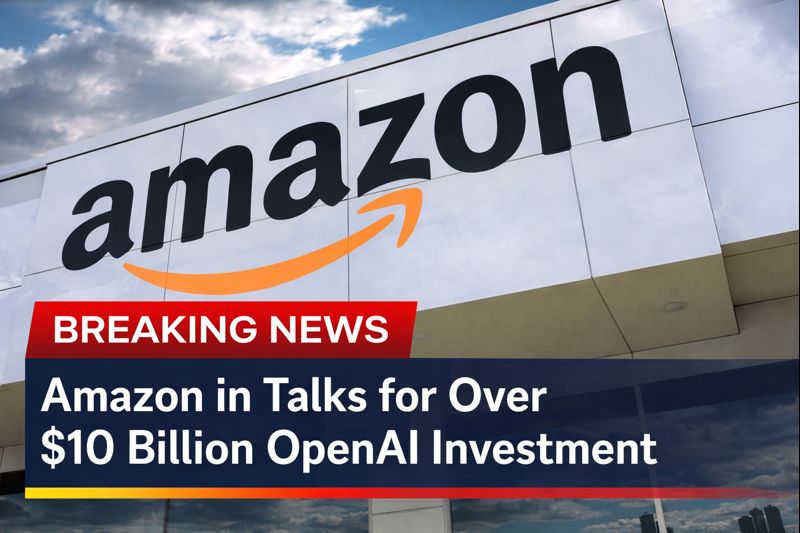
Breaking news. The global artificial intelligence race has entered a decisive new phase. According to multiple reports, Amazon is in early discussions to invest more than 10 billion dollars in OpenAI. As a result, the move could push OpenAI’s valuation beyond 500 billion dollars and lay the groundwork for a potential 1 trillion dollar initial public offering.
If confirmed, the Amazon OpenAI deal would become one of the largest private technology investments in history. More importantly, it highlights a clear shift in the AI industry. Instead of focusing only on model development, power is now moving toward control of compute, chips, cloud infrastructure, and capital.
The AI Capital Race Is Accelerating, Not Slowing Down
Despite recent speculation that AI investment momentum might cool, the opposite is now happening. In fact, a new power axis is emerging across the global AI ecosystem. At the same time, capital deployment is accelerating at an unprecedented pace.
Amazon’s potential investment of more than 10 billion dollars in OpenAI sends a strong signal to the market. Therefore, the AI capital race is intensifying. With a valuation exceeding 500 billion dollars, OpenAI is no longer just a leading model developer. Instead, it has become the most strategically valuable AI company in the world, capable of anchoring massive multi year cloud compute demand.
Industry analysts describe this moment as a turning point. Financial scale, infrastructure ownership, and long term compute guarantees now matter more than short term model releases.

OpenAI’s Strategic Reset Makes the Amazon OpenAI Deal Possible
Earlier this year, OpenAI quietly restructured its corporate and partnership framework. The company transitioned into a public benefit corporation. Meanwhile, Microsoft, its long time strategic partner, retained a reported 27 percent ownership stake.
However, this restructuring gave OpenAI far greater flexibility. The company can now raise capital independently, diversify its cloud dependencies, and form broader strategic alliances beyond a single ecosystem.
The reported Amazon OpenAI deal appears to validate this strategic reset. OpenAI is no longer locked into one cloud provider, one chip supplier, or one strategic gatekeeper. Instead, it is positioning itself as a platform level AI company with leverage across the entire infrastructure landscape.
Amazon’s Tranium Chips Could Play a Central Role
One of the most important aspects of the Amazon OpenAI deal is the potential adoption of Amazon’s Tranium AI chips.
Tranium is Amazon’s in house AI accelerator. It is designed to deliver high performance at lower cost while improving energy efficiency compared to traditional GPU based solutions. Moreover, these chips are deeply integrated with AWS and optimized for large scale AI training and inference workloads.
If OpenAI adopts Tranium, even for part of its compute needs, it would strongly validate Amazon’s silicon strategy. As a result, AWS could significantly strengthen its position in AI workloads. This is especially important in an area where it has historically faced intense competition from Microsoft Azure.
In a market long dominated by Nvidia, Tranium is increasingly seen as a quiet but serious challenger.
The AI Infrastructure War Comes Into Focus
Across the industry, a clear pattern is now emerging. Leading AI model developers, cloud providers, and chip platforms are forming deep, long term compute alliances. These partnerships increasingly resemble industrial scale infrastructure financing rather than traditional tech collaborations.
The competitive landscape is becoming clearer. Amazon is aligning Tranium with OpenAI. Microsoft continues to pair Azure with OpenAI. Meanwhile, Google is advancing Gemini using its proprietary TPUs.
Each cloud giant is racing to secure proprietary chips, lock in flagship AI customers, and guarantee predictable multi year compute demand. In this context, OpenAI stands out as the most valuable anchor customer in the global AI market.
Nvidia remains a dominant force. However, growing pressure is emerging as cloud providers seek to reduce reliance on external chip suppliers.
Pre IPO Strategy and the Road to a Trillion Dollar Valuation
Sources familiar with the matter suggest OpenAI is laying the groundwork for an eventual IPO. If successful, the listing could value the company at up to 1 trillion dollars, making it one of the largest technology offerings in history.
For Amazon, the Amazon OpenAI deal would go far beyond financial returns. It could secure long term AI compute demand for AWS, reduce exposure to rival cloud platforms, and strengthen governance optics. In addition, it would signal long term confidence in OpenAI’s sustainability.
Industry observers describe this phase as pre IPO chess. Every alliance, investment, and infrastructure decision is designed to strengthen positioning ahead of public markets.
The Bigger Picture: Owning the AI Stack
The implications of the Amazon OpenAI deal extend far beyond the two companies. They reflect a broader shift in how AI dominance is defined.
Over the last decade, artificial intelligence focused on building better models. In contrast, the next decade will be defined by owning the entire AI stack. This includes chips, compute, cloud platforms, and access to capital.
If the last decade was about creating intelligence, the next decade will be about controlling the infrastructure that powers it.powers it.
